Quick Hits
Herman Miller and Steelcase represent the gold standard of professional office gear, but they cater to very different work styles. Herman Miller chairs like the Aeron and Embody are precision instruments designed to correct your posture and keep you cool with advanced mesh or pixelated support. They are ideal if you prefer to sit in a structured, upright position for deep focus work. In contrast, Steelcase chairs like the Leap V2 and Gesture are built for flexibility, allowing you to fidget, recline, or even sit cross-legged without the constraints of a rigid frame. While Herman Miller often wins on iconic design and breathability, Steelcase generally offers more intuitive adjustments and a more forgiving fit for various body types. For standing desks, Steelcase provides robust, commercially-rated frames like the Migration SE, though many professionals now pair these high-end frames with custom wood tops to save money without sacrificing stability.
Introduction: Defining the High-End Home Office
After testing dozens of chairs and desk configurations over years of eight-hour workdays, I’ve learned that the “best” setup is rarely about the most expensive item on the menu. It is about how that gear interacts with your body during the 2:00 PM slump. When you transition from a corporate-provided cubicle to a home-grown professional workspace, the choice usually boils down to two titans: Herman Miller and Steelcase. These brands dominate the executive market not just because of their price tags, but because they design products intended to last over a decade under constant use.
You might find yourself torn between the iconic silhouette of a Herman Miller Aeron and the tank-like reliability of a Steelcase Leap. One is a statement piece that forces you into healthy habits; the other is a versatile tool that adapts to however you happen to be sitting at the moment. Choosing between them requires an honest look at your “sitting personality.” Do you sit like a statue while you code, or do you lean back, tuck a leg under, and move constantly while on calls? Your answer dictates which of these brands will actually protect your back in the long run. As you refine your desk and workspace setups, understanding these ergonomic nuances becomes the difference between a productive afternoon and a week of physical therapy.
The Professional’s Comparison Table
| Product Name | Best For | Price Range | Pros/Cons | Visit |
|---|---|---|---|---|
| Herman Miller Aeron | Strict posture & breathability | $1,200 – $1,800 | Cool mesh; classic design / Rigid frame; limited movement | |
| Steelcase Leap V2 | All-day ergonomic flexibility | $1,100 – $1,400 | Best-in-class back support / Can feel “plastic” at first | |
| Herman Miller Embody | Deep focus & spinal health | $1,600 – $2,000 | Pixelated support system / Noisy (creaks); very expensive | |
| Steelcase Gesture | Multi-device users (Tablets/Phones) | $1,300 – $1,600 | Most adjustable arms / Lumbar is too subtle for some |
The Seating Showdown: Flagship Comparisons
Herman Miller Aeron
The Aeron is less of a chair and more of a machine. Its Pellicle mesh is legendary for a reason—it suspends your body weight evenly, eliminating pressure points while allowing your skin to breathe. If your home office gets warm in the summer, this is your best friend. However, the Aeron is famous for its “posture police” reputation. The hard plastic rim around the seat pan is unforgiving; it forces you to sit with your feet flat on the floor. In my experience, if you try to sit cross-legged or even tuck a foot under your thigh, that plastic edge will quickly remind you why you shouldn’t.
What Works
- Unmatched breathability—perfect for hot climates or long sessions.
- The recline mechanism is buttery smooth and balanced.
- Extremely durable; these chairs often last 15-20 years.
What Doesn’t
- The rigid seat frame can cause hamstring pressure if you aren’t the exact right size for your Aeron (A, B, or C).
- It is practically impossible to sit in any position other than “properly upright.”
Worth It? Best for deep focus workers who stay in one position and want to stay cool. Skip if you like to sit cross-legged or move around frequently.
Steelcase Leap V2
If the Aeron is a rigid specialist, the Steelcase Leap V2 is the ultimate all-rounder. Your back is supported by a flexible spine system that moves as you lean, twist, or reach for a coffee. The seat pan is padded rather than mesh, which many find more comfortable for 10-hour days. It offers “LiveBack” technology that mimics your spine’s natural curve, making it one of the most ergonomic chairs ever designed. In practice, the Leap feels like a warm hug for your lower back, providing more aggressive lumbar support than the more modern Gesture.
What Works
- Highly adjustable lumbar firmness and height.
- The flexible front edge of the seat pan reduces pressure on the back of your legs.
- Intuitive controls that are easy to adjust while you’re actually sitting.
What Doesn’t
- The backrest can feel a bit “short” for taller users (over 6’2″).
- Fabric seats can trap heat compared to mesh alternatives.
Worth It? Best for anyone with lower back pain who needs a chair that moves with them. Skip if you prioritize a high-tech, breathable mesh look.
Herman Miller Embody
The Embody was designed specifically for people who spend their entire lives in front of a computer. It features a “pixelated” support system—a matrix of small points that distribute your weight as you shift. Unlike the Aeron, the Embody has no hard frame around the edges, allowing you to move your shoulders and arms more freely. It feels like you are floating. When I sat in the Gaming Embody variant, I noticed the additional foam layer made a massive difference in long-term comfort compared to the standard model.
What Works
- Excellent for spinal alignment; the backrest adjusts to the specific curve of your back.
- No hard edges—you can sit in various positions without hitting plastic.
- Modern, “space-age” aesthetic that serves as a centerpiece for any setup.
What Doesn’t
- The backrest can be noisy; many users report a “creaking” sound when moving.
- The price point is significantly higher than almost any other standard office chair.
Worth It? Best for tech professionals who want the most advanced spinal support money can buy. Skip if you are sensitive to clicking or creaking noises from your furniture.
Steelcase Gesture
The Gesture was created after Steelcase studied how people use modern devices like tablets and smartphones. Its standout feature is the 360-degree armrests. They can move in almost any direction, supporting your elbows whether you’re typing on a traditional keyboard or leaning back to look at a phone. It feels more “heavy-duty” than the Leap and has a cleaner, more residential design. However, some users find the seat to be a bit firm, and the lumbar support isn’t as pronounced as the Leap’s.
What Works
- The best armrests in the industry, hands down.
- Fits a wider range of body sizes (from 5th to 95th percentile) than the Aeron.
- Very smooth rolling casters that work well on both carpet and hardwood.
What Doesn’t
- The seat padding can feel “bottomed out” for heavier users after several hours.
- Lumbar support is relatively flat; if you need a “bump” in your back, this might not be it.
Worth It? Best for multi-device users who constantly shift positions. Skip if you require aggressive, height-adjustable lumbar support.
Mid-Range Contenders: Sayl vs. Series 1
If you’re not ready to drop $1,500 on a chair, both brands offer entry-level professional options. The Herman Miller Sayl is a design icon with a frameless back inspired by the Golden Gate Bridge. It offers surprising comfort for its size but lacks the deep ergonomic features of its bigger siblings. On the other side, the Steelcase Series 1 provides the core Steelcase experience—great arms and a flexible back—at a much more accessible price. For more affordable ideas, check out our guide on ergonomic seating reviews to find the right balance for your budget.
The Standing Desk Equation: Frames and Surfaces
Steelcase Migration SE vs. Herman Miller Solutions
While their chairs get all the glory, their desks are the quiet workhorses. The Steelcase Migration SE is built like a tank. It doesn’t wobble at full height, which is the primary complaint about cheaper standing desks. With a 12-year warranty on the frame and electronics, it’s a “buy it for life” investment. Herman Miller desks are equally sturdy but often come with a higher price tag for the brand name alone. For professionals using dual monitor setups, the weight capacity of these frames is critical; a cheap desk will struggle with two 27-inch monitors and a heavy desktop PC.
The ‘Butcher Block’ Hack: Why OEM Tops Aren’t Always Best
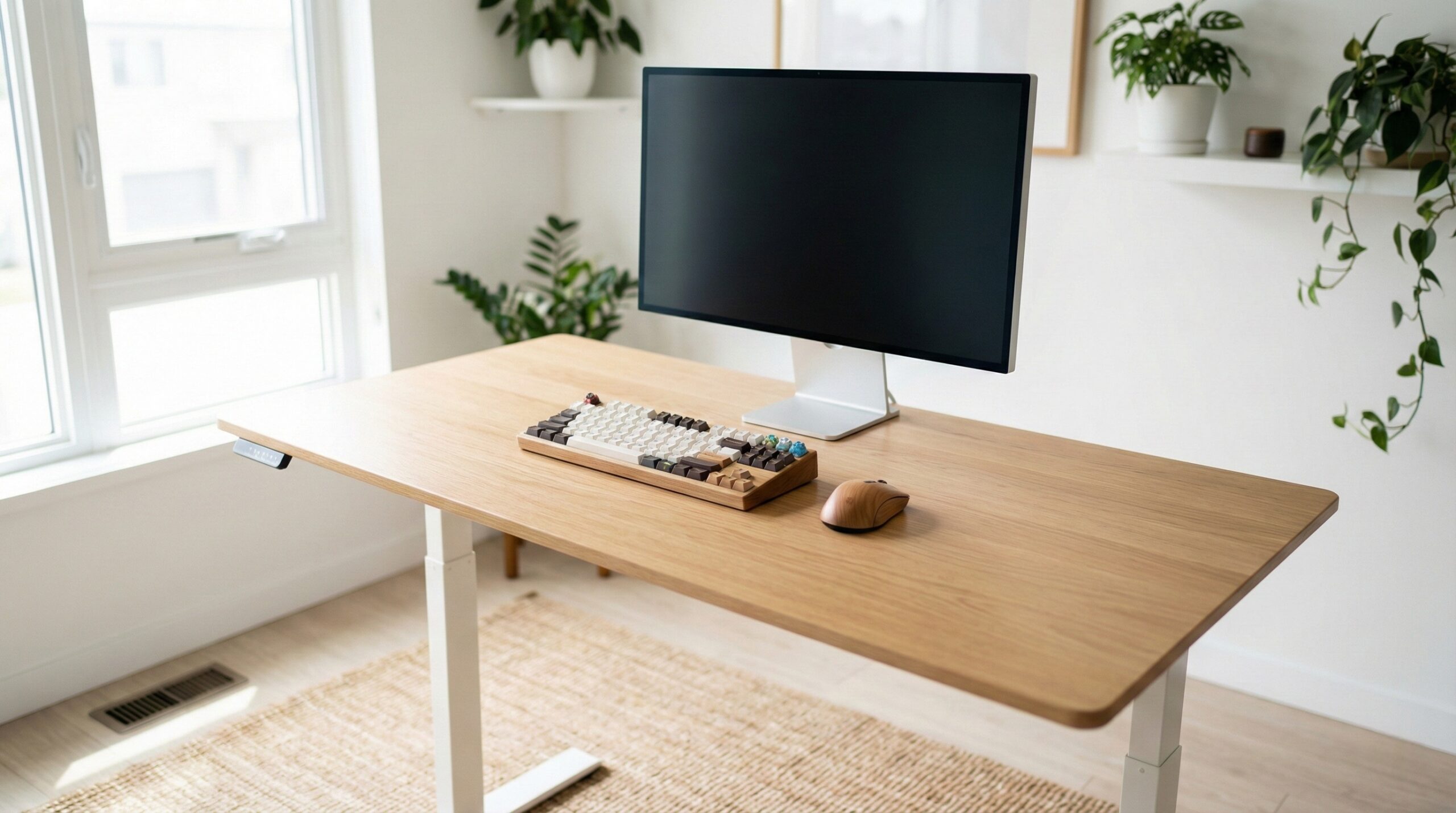
One of the best pieces of advice I’ve gathered from the professional community is to skip the expensive laminate or veneer tops offered by Herman Miller or Steelcase. Instead, buy a high-end frame like the Migration SE or a Deskhaus Apex Pro and head to a hardware store. You can find a solid birch or oak butcher block for a fraction of the price of an “official” desktop. It’s thicker, more durable, and gives your office a warm, custom feel. This hack allows you to divert more of your budget toward a better chair, which is where the ergonomics truly matter.
What Real Users Are Saying (Reddit Insights)
General Sentiment
Across communities like r/OfficeChairs and r/StandingDesk, the consensus is clear: Steelcase is for comfort, while Herman Miller is for correction. Most users describe the shift to these high-end brands as a revelation, especially those coming from “gaming” chairs. The consensus is that while the initial cost is painful, the reduction in back and neck fatigue is immediate. As noted in several tech peripherals and accessories discussions, the chair is the most important “peripheral” you will ever own.
Top Complaints & Warnings
Despite the high price, no chair is perfect. Users on Reddit frequently warn about the “Aeron Hamstring Issue,” where the seat’s front rim cuts off circulation if your legs are too short or your chair is too high. Another common warning involves the Gesture’s lumbar support, which some claim is almost non-existent compared to the Leap.
“If you have any muscle on your hamstrings, the frame of the Aeron will be extremely difficult to ignore. I still can’t get over how cramped my legs feel after an hour.” — r/OfficeChairs
“The Gesture armrests are magic, but the seat felt like a $300 Staples chair to me. I swapped for a Leap and my back is much happier.” — r/OfficeChairs
Budget Tips & Value Picks
The savvy community recommendation is often to look for “open box” or refurbished units from reputable liquidators. You can often find a Leap V2 or Aeron for 50% of the retail price with a 5-year warranty from specialized resellers. Additionally, users suggest that for standing desks, spending more on the frame (like the Ergotron vs Vari comparisons suggest) is always better than spending on a fancy wood top from the manufacturer.
Setup Synergy: How to Choose for Your Work Style
If you are a “Deep Worker”—someone who sits down and doesn’t move for four hours while focused on a single task—you want a Herman Miller. The Aeron or Embody will keep your spine in the optimal position to prevent the “C-curve” slump. They reward discipline.
If you are a “Multi-Tasker”—someone who is on Zoom calls, then checking a tablet, then leaning back to think, then leaning forward to write notes—you want a Steelcase. The Gesture and Leap are designed for movement. They don’t punish you for sitting “wrong.” For those with limited space, pairing these with desk shelves for narrow desks can help maximize your footprint without losing ergonomic benefits.
The Essential Add-ons
Neither Herman Miller nor Steelcase is known for great headrests. In fact, many Herman Miller chairs don’t come with one at all. If you want a headrest for your Aeron or Embody, the community-standard is the Atlas Headrest. It’s an after-market addition that perfectly matches the materials and provides the neck support the original designers omitted. For those with hardwood floors, replacing the standard plastic casters with “rollerblade style” wheels is another high-value upgrade that makes moving your 50-pound chair silent and smooth.
Best Chairs by Work Style
Best for Posture Correction
The Herman Miller Aeron is the undisputed king here. Its rigid frame and mesh suspension simply won’t let you slouch. It’s the best choice for those who want to fix their sitting habits in 2026 and beyond.
Best for Fidgeters and Cross-Legged Sitting
The Steelcase Leap V2 or Steelcase Amia are your best bets. Because they use traditional cushions and have flexible seat edges, they accommodate various positions that would be painful in a mesh chair.
Best for Small Home Offices
The Herman Miller Sayl has a smaller footprint and a light, airy design that doesn’t overwhelm a small room. It’s perfect for hybrid setups that need to blend into a living space.
Frequently Asked Questions
Is the Herman Miller Aeron good for sitting cross-legged?
No, the Herman Miller Aeron is generally poor for sitting cross-legged. The seat pan is surrounded by a rigid plastic frame designed to support the mesh. If you cross your legs, your ankles or feet will likely press against this hard plastic, causing discomfort. For a better experience sitting cross-legged, consider the Steelcase Leap V2 or the Herman Miller Embody, which lack that restrictive outer frame.
Why do professionals recommend buying a standing desk frame and tabletop separately?
Professionals recommend this “hack” because high-end manufacturers like Steelcase charge a premium for their desktops, which are often just laminate over particle board. By purchasing a high-quality frame like the Steelcase Migration SE and pairing it with a solid wood butcher block from a hardware store, you get a more durable, aesthetically pleasing surface while saving hundreds of dollars that can be better spent on an ergonomic chair.
Which chair has better lumbar support: the Steelcase Gesture or the Herman Miller Aeron?
The Herman Miller Aeron offers more pronounced, adjustable lumbar support, specifically with its PostureFit SL system which supports the sacrum and the lumbar spine. While the Steelcase Gesture is highly adjustable, many users find its lumbar support to be more subtle or “flat.” If you require a strong, noticeable push in your lower back, the Aeron or the Steelcase Leap V2 are superior choices.
Is the Steelcase 12-year warranty better than Herman Miller’s?
Both brands offer excellent 12-year warranties, but the “quality” of service can vary. Steelcase is often praised for its “no-hassle” approach, frequently shipping entire replacement parts without much friction. Some users have reported that Herman Miller can be more difficult to work with regarding build defects on newer units, though they still remain far better than the 1-3 year warranties found on budget chairs.
Are Herman Miller chairs worth the price for a WFH setup?
Yes, if you plan to work from home for the foreseeable future, a Herman Miller chair like the Embody or Aeron is a wise investment. They are designed to prevent long-term repetitive strain injuries and are built to last over a decade. When you break down the cost over 12 years, you are paying very little per day for a tool that significantly impacts your health and daily productivity.
Final Verdict: Building Your Ultimate Professional Setup
Choosing between Herman Miller and Steelcase isn’t about which brand is “better”—it’s about which philosophy matches your body’s needs. If you want the cooling sensation of mesh and a chair that encourages perfect posture, Herman Miller is the way to go. If you want a chair that feels like a natural extension of your body and allows for constant movement, Steelcase will likely be your favorite. Regardless of which brand you choose, remember that the chair is only half the battle. Pairing your seat with a stable standing desk and organized productivity tools creates an environment where you can actually do your best work without the distraction of physical pain. Investing in your workspace is ultimately an investment in your career longevity.
This page includes affiliate links. Purchases through these links support our work at no added cost.