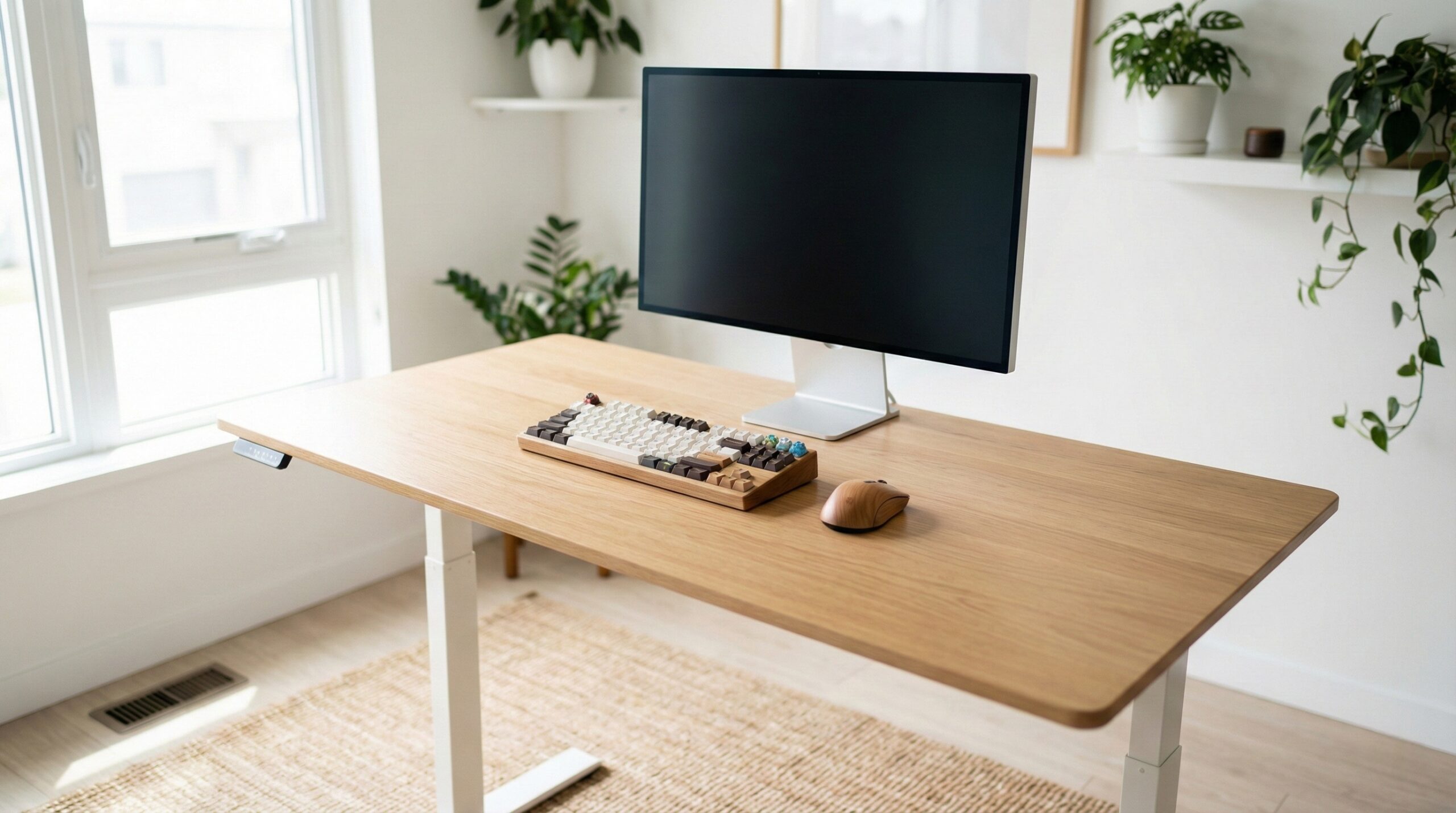
TL;DR
The Jarvis standing desk (the classic Fully Jarvis, now sold via Herman Miller) is a solid pick if you want a reputable electric sit-stand desk with lots of top sizes and finishes — so long as you choose the right top and plan your monitor-arm/cable setup up front. Most “bad Jarvis experiences” come down to stability at tall standing heights or a setup that’s heavier and more front-loaded than people expect.
What Jarvis Standing Desk Actually Is
The “Jarvis standing desk” people search for is the electric sit-stand desk originally sold by Fully (as the Fully Jarvis). Today, the most reliable way to identify what you’re actually buying is to treat “Jarvis” as a line (frame + compatible tops/accessories) that may be listed through the Herman Miller store, with policies and bundles that can differ from older Fully-era blog posts and YouTube reviews.
At its core, Jarvis is an electric height-adjustable desk built around three decisions that determine how happy you’ll be long-term:
- The base (frame + lifting columns): This drives height range, how the desk feels at standing height, and how it handles your total load. Even when a desk has a high advertised capacity, real-world performance depends on how that weight is distributed (centered vs. front-heavy) and whether you’re amplifying movement with a long monitor arm.
- The desktop (top) you choose: Jarvis is known for offering multiple top materials and sizes. In practical terms, most buyers are choosing between a more “natural” surface (like bamboo) and a more “uniform/low-maintenance” surface (like laminate). This choice affects how the surface holds up to daily wear, writing pressure, hot mugs, and especially clamps (monitor arms, mic arms, task lights).
- Your configuration: Monitor arms, where your gear sits, and how you route cables matter as much as the desk itself. A dual-monitor arm extended forward can increase perceived wobble at standing height; messy cable routing can limit travel or snag when you raise/lower the desk.
Think of Jarvis as a “mainstream, flexible platform” rather than a one-size-fits-all desk. Your best outcome usually comes from speccing it like a system: pick a top that fits your equipment footprint, keep heavier items centered over the frame, and confirm the current listing details (what’s included, lead times, warranty/returns, and who handles support) before you check out.
Also: a standing desk is only one piece of ergonomics. Agencies like NIOSH emphasize reducing musculoskeletal strain by improving workstation fit and varying posture, not simply standing all day. You’ll get better results when your monitor, keyboard, and mouse positions follow basic workstation guidance (see OSHA computer workstations eTool for practical setup concepts).
Who Jarvis Standing Desk Fits Best
Jarvis tends to work best for home office workers who want a well-known electric sit-stand desk with lots of top options — and who are willing to plan their setup instead of treating the desk as a generic slab.
- You want lots of surface choices without going fully custom. If you care about the look/feel of the top (and want sizes that match your space), Jarvis’ appeal is the menu of finishes and footprints.
- You’re building a “normal-to-moderate” load setup. Laptop + dock + one or two monitors is typical. The key is keeping weight centered and not pushing heavy gear out on long arms.
- You’re okay doing a little planning to avoid wobble. Any two-leg standing desk can feel less solid as it gets taller. If you’re realistic about that — and you’re willing to place gear thoughtfully — you’re the right kind of buyer.
- You like the idea of iterating your ergonomics. If you’ll actually set your monitor height, keep the keyboard/mouse at a neutral height, and use a mat or supportive footwear for standing sessions, you’ll benefit more from the desk.
Where Jarvis buyers often sound happiest is when the desk matches their space and workflow rather than being “the desk everyone on Reddit mentions.” For example: “Easy to assemble and the height presets are super convenient for switching between sitting and standing during the day.
” —
If you’re unsure whether a standing desk will help, evidence indicates sit-stand workstations can reduce sitting time for many people, but the comfort outcome depends on setup habits (alternating positions, proper monitor/keyboard placement) rather than standing nonstop. If pain or numbness is part of your reason for switching, it’s also worth running your setup past a certified ergonomist or occupational therapist.
Who Should Skip Jarvis Standing Desk
Jarvis isn’t “bad” for these situations — but it’s easier to be disappointed if any of the points below describe you.
- You’re tall and very sensitive to wobble at full standing height. As the desk rises, leverage increases and movement is more noticeable. If you type with a heavy hand, use extended monitor arms, or you’re bothered by any shake, Jarvis may not be your best match without mitigation strategies (gear placement, arm choice, nearby wall positioning without contact, etc.).
- You run a heavy, front-loaded monitor-arm setup (or plan to). Dual monitor arms, big ultrawides, and “everything on clamps” can amplify movement and stress the front edge of some tops. If you already know you’ll be clamping a lot of gear, you may want to prioritize a top material that tolerates clamping and choose the deepest top that fits your room.
- You want a desk that feels like a fixed workbench. If your expectation is “zero movement, ever,” most two-leg electric desks will disappoint at standing height — especially on soft carpet or uneven floors.
- You don’t want to think about the rest of ergonomics. If you buy a standing desk but keep your monitors too low, or stand on a hard floor for hours, discomfort can persist. OSHA’s guidance on workstation positioning is a good reminder that the desk is only one element of fit (OSHA computer workstations eTool).
Critical buyer feedback often centers on stability or expectations at standing height. One example: “At standing height it wobbles more than I expected, especially with my monitor arm.
” —
Price and Value
Jarvis pricing tends to vary with the top size, top material, and any bundle/accessory choices (like cable management, casters, or power add-ons). Because Jarvis is now commonly purchased through the Herman Miller storefront, you should treat the current product page as the source of truth for:
- What’s included (frame, top, handset/controller, grommets, basic cable routing pieces)
- Warranty length and return policy (policies can change over time and may not match older “Fully” references)
- Lead times (large tops can ship separately or take longer)
In value terms, Jarvis is usually “worth it” when you actually use the flexibility you’re paying for: you choose a top that fits your monitors at a safe viewing distance, you pick a surface that matches how you work (clamps vs. no clamps), and you set up your workstation so sitting and standing are comfortable. If you buy a small top and then add a wide monitor setup, or you clamp heavy accessories to a delicate surface, you’re less likely to feel like the desk was a good deal.
If your budget is tight, the best “value move” often isn’t a cheaper desk — it’s avoiding the common add-on costs that come from poor planning (replacement top, different monitor arm, extra cable management, a better mat). Plan the system once, buy once.
Common Mistakes When Trying Jarvis Standing Desk
Most problems we see with Jarvis (and standing desks generally) come from configuration mistakes, not outright defects. Here are the big ones to avoid.
- Underestimating your real payload. Don’t count only monitors. Your total load is: desktop top + monitors + monitor arms + laptop/dock + speakers + any mounted accessories. If you’re near the limit — or if the load is front-heavy — you can get slower lifting, more wobble, and more stress on components over time.
- Choosing a top that’s too small for your actual monitor layout. A cramped surface pushes monitors too close, forces awkward keyboard/mouse placement, and concentrates weight in less stable positions. If you’re debating between two sizes, the bigger top (that still fits your room) is often the smarter ergonomic choice.
- Picking the wrong top material for clamping. If you already know you’ll use a monitor arm, mic arm, or light clamp, pick a surface that tolerates pressure and consider using protective pads. Some buyer frustrations are really “top mismatch” issues.
- Mounting heavy gear at the front edge. Front-loaded setups increase perceived wobble and clamp stress. Try to keep the heaviest items centered over the frame structure and avoid extended arms that place weight far forward.
- Ignoring cable slack and snag points. A sit-stand desk changes the cable geometry every time it moves. Leave slack for the full travel range, and route cables so they can’t catch on the frame or pull on devices.
- Standing too long, too soon. If you go from “sit all day” to “stand all morning,” your feet, calves, and lower back may complain. Research suggests gradual transitions work better (alternate in shorter blocks, then increase standing time as tolerated). A mat helps a lot for many people.
One of the most common owner regrets is buying first and planning later: “I wish I’d bought a bigger top — once I added the monitor arm and speakers it felt cramped.
” —
Safety note: keep hands, pets, and cables clear while the desk is moving, and don’t leave it raising/lowering unattended. Also avoid overloading power strips and keep liquids away from the control box/handset.
FAQ
Is the Jarvis standing desk the same thing as the Fully Jarvis?
“Jarvis” typically refers to the desk line that was formerly sold under the Fully brand. Today, it’s commonly purchased through Herman Miller’s storefront, so the safest approach is to verify the current listing details (what’s included, warranty/returns, and who handles support) on the page you’re buying from.
How do I choose between a bamboo top and a laminate top?
Choose bamboo if you want a natural look/feel and you’re comfortable treating it like a wood surface (more attention to coasters, writing pressure, and clamp protection). Choose laminate if you want a more uniform, generally lower-maintenance surface — especially if you frequently clamp accessories like monitor arms or task lights.
Rectangle or contour desktop: which is better for ergonomics?
Rectangle tops usually give you maximum usable depth, which helps you place monitors at a comfortable viewing distance and still have room for keyboard/mouse. Contour tops can feel nicer on the forearms at the front edge, but make sure you still have enough depth for your monitor distance and any arm/clamp hardware behind the screen.
Will a Jarvis desk wobble at standing height?
Some movement at standing height is normal for most two-leg electric desks, and it tends to be more noticeable for taller users and with extended monitor arms. You can often reduce wobble by centering heavy items over the frame, reducing monitor-arm extension, making sure the desk is level, and avoiding front-heavy loads. If you’re unsure about posture and positioning, the OSHA computer workstations eTool is a useful reference for monitor/keyboard placement basics.
How do I estimate if my setup is too heavy for an electric standing desk?
Add up the weights of the desktop itself (the top), your monitors, monitor arms, laptop/dock, speakers, and any mounted accessories. Then leave a buffer rather than building right up to the rated limit. Real-world performance is affected not only by total weight but also by where the weight sits (centered vs. front edge) and how much leverage a monitor arm introduces.
How long should I stand at my desk each day?
There’s no single perfect number. Evidence indicates that alternating between sitting and standing can reduce total sitting time, but standing all day can create its own discomfort. Many people do best with shorter standing intervals and gradual increases, focusing on comfort and neutral posture. If you’re managing pain, consider guidance from a certified ergonomist or occupational therapist, and review general ergonomics principles from institutions like OSHA and NIOSH.
What are the biggest safety issues with standing desks?
Main issues are pinch/crush hazards while the desk is moving, cable snagging that can pull equipment, electrical safety (don’t overload power strips; keep liquids away from electronics), and tipping risk from extreme front-loaded setups. Keep the heaviest items centered, route cables with slack for full travel, and keep hands/pets clear during adjustments.
Looking for these on Amazon? Browse jarvis standing desk on Amazon →
Bottom Line
Buy the Jarvis standing desk if you want a proven electric sit-stand desk with lots of top choices and you’re willing to configure it thoughtfully for your height and equipment. Skip it if you’re extremely wobble-sensitive at tall standing heights or you’re planning a heavy, extended monitor-arm setup without room to size up the top and manage weight placement.
Affiliate disclosure: This page includes affiliate links. Purchases through these links support our work at no added cost.