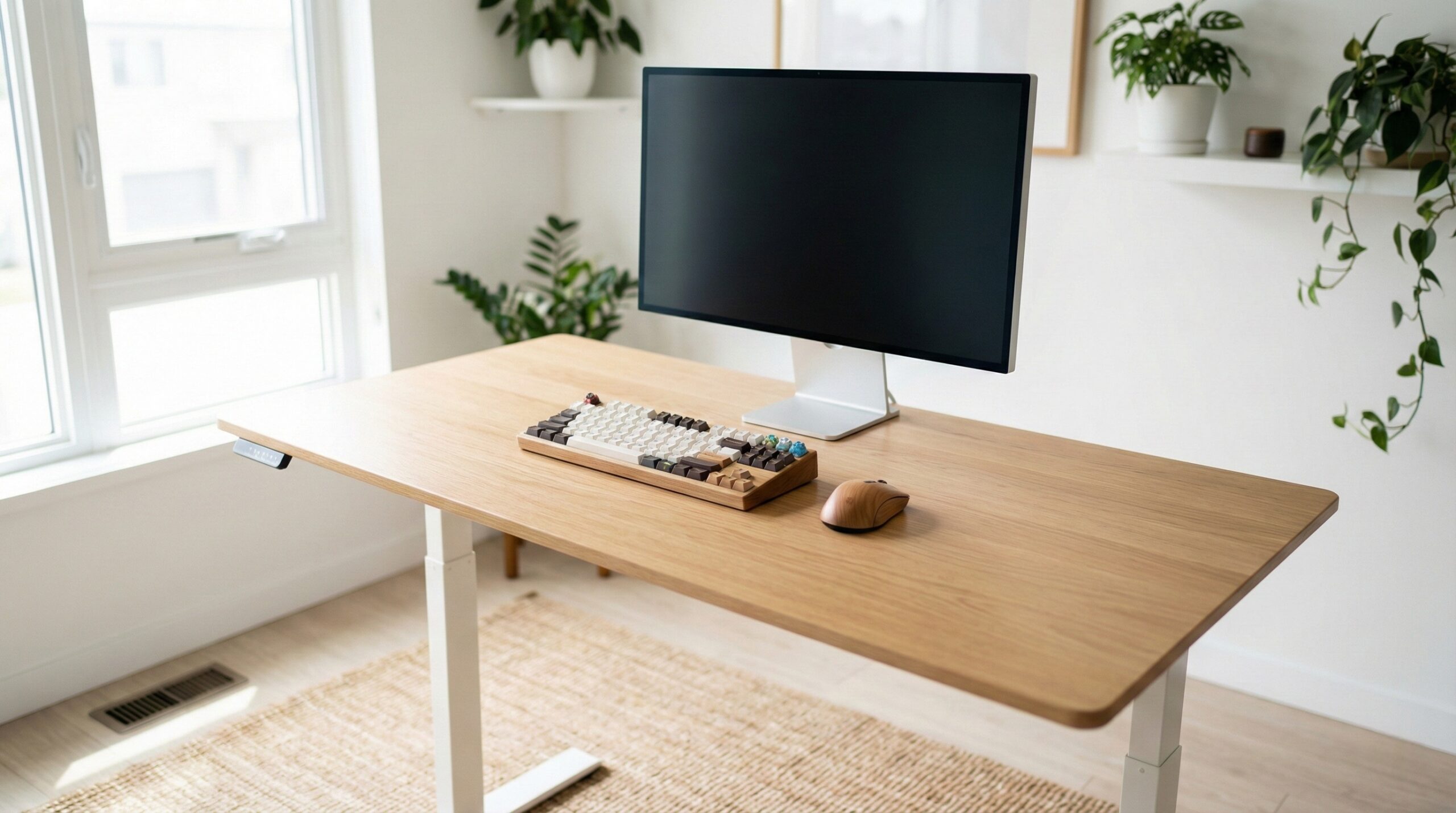
TL;DR
Standing desk legs (a.k.a. the frame) matter more than most people think: they determine your height range, how stable the desk feels at standing height, and how much weight it can lift day after day. For most home offices — especially dual monitors or heavier tops — we’d start with a dual-motor, 3-stage frame with wide feet, solid bracing, and a controller with memory presets; just plan on careful assembly and drilling pilot holes into your top.
What Standing Desk Legs Actually Is
“Standing desk legs” usually means the electric sit-stand frame only — the lifting columns, feet, motors, rails/crossmembers, and the controller you mount under a desktop. You supply the top (or reuse the one you already own), then bolt everything together so the frame can raise and lower the surface to seated and standing heights.
That’s why legs are the make-or-break component for a standing desk. The frame determines:
- Height range (how low it goes for comfortable seated posture, and how high it reaches for standing). This is the first “fit” check — especially for shorter users who need a lower minimum height, and taller users who need a higher maximum height.
- Stability (how much the desk wobbles at standing height). Wobble tends to increase the more the legs extend, so it’s not enough to be stable at mid-height; you want stability at your actual standing height.
- Lift capacity (how much weight it can move repeatedly). The real load is your desktop + monitor(s) + monitor arms + accessories. Also, weight ratings generally assume a reasonably even load; a heavy PC tower on one side or a big monitor arm can amplify sway and stress the frame.
- Daily usability (controller quality, memory presets, anti-collision behavior, noise, speed). If changing positions is annoying, people stop doing it.
Buying legs instead of a full desk can also be the smarter value play. You can keep a top you already like (solid wood, butcher block, a specific color/finish), put more of your budget into motors/columns/controller, and choose a frame that supports your exact width range — useful if you want extra-wide or nonstandard dimensions. The tradeoff is you’re taking on more responsibility: measuring, aligning, drilling pilot holes, and securing screws correctly for your top material so the desk doesn’t loosen over time.
From an ergonomics standpoint, evidence-based guidance (like OSHA workstation recommendations) emphasizes matching desk height to neutral posture — forearms roughly level, shoulders relaxed, wrists straight. When you switch between sitting and standing, the best frame is the one that can reliably hit your heights, smoothly, every day. If you’re unsure, a certified ergonomist or occupational therapist can help you dial in heights and monitor/keyboard setup for your body and work style. For background on workstation setup, see OSHA computer workstation guidance.
Who Standing Desk Legs Fits Best
Standing desk legs are a great fit if you want the flexibility of a custom top, care about stability at standing height, or you’re trying to build a more ergonomic home office without paying for a bundled desktop you’ll replace anyway. In practice, we see legs-only make the most sense in a few scenarios:
- You already own a desktop you like (solid wood, butcher block, an IKEA top, etc.) and want to convert it to sit-stand.
- You want a wider or nonstandard desktop and need a frame with adjustable rails that can support that width range.
- You run heavier gear (dual monitors, a big ultrawide, monitor arms, desktop speakers). Dual-motor frames generally handle weight and off-center loads more smoothly.
- You’re shorter or taller than average and need a broader height range. 3-stage lifting columns are often the safer bet for hitting both a low seated height and a tall standing height.
- You actually plan to change positions frequently and want memory presets so you’re not “holding the button” and guessing every time.
Buyer feedback often highlights the “frame-only” appeal: you get to focus spend on the parts that matter (columns, motors, crossmembers), then pick a top that matches your room. On the value end, some users are also pleasantly surprised by how complete a legs-only kit can feel when packaging/parts are done right. For example: “First of all I was impressed with the packaging. It came in a very sturdy cardboard box. Every piece was individually wrapped and embedded in foam.” — verified buyer, 5 stars
If you’re doing this to reduce all-day sitting, it’s also worth keeping expectations realistic: research reviews suggest sit-stand workstations can reduce sitting time, but outcomes like pain relief vary and depend heavily on setup and how you use it. A practical starting point is alternating positions and keeping keyboard/mouse and monitor height correct. For a broader evidence summary, see the Cochrane Library (search sit-stand workstation reviews).
Who Should Skip Standing Desk Legs
Legs-only isn’t for everyone. You may be happier with a complete standing desk (frame + top) or a converter if any of these apply:
- You don’t want to drill or measure. Most frames require pilot holes into your top. If you’re not comfortable aligning the frame, squaring it, and choosing the right screw length for your desktop material, a pre-drilled bundled desk can be less stressful.
- You need strong safety features. Not every frame includes robust anti-collision detection, child lock/button lockout, or predictable “stop and reverse” behavior. In a shared home office (kids/pets), those features matter.
- You’re extremely sensitive to wobble. Any frame will be less stable at full extension. If you type with a heavy hand, use a tall monitor arm, or plan to stand near the desk’s max height, you may need to spend more for a more rigid base (or accept some movement).
- You need a fast, low-effort solution. A frame build can take real time — especially if you add cable management, a CPU mount, or under-desk drawers.
One of the most common “skip” reasons in user reports is missing safety/lock features at certain price points. A representative critical note: “I just wish it had child lock or anti collision protection. BUT for the price it’s a great buy.” — verified buyer, 4 stars
Also consider basic safety: pinch/crush hazards are real when the desk is moving, and tip risk can increase with tall standing height, narrow stance, and heavy monitor arms. Guidance on reducing musculoskeletal strain also emphasizes avoiding awkward postures and ensuring your setup supports neutral joint angles; see NIOSH ergonomics resources for background on MSD risk factors.
Price and Value
Standing desk legs span a wide price range, but for mainstream electric frames, a realistic “good value” band is often in the mid-hundreds — especially if you want dual motors and 3-stage legs.
- TOPSKY Dual Motor Electric Standing Desk Frame: typically $200–$250.
- VIVO Dual Motor Electric Sit-Stand Desk Frame (220 lbs): typically $175–$200.
- FLEXISPOT E6 Dual Motor Standing Desk Frame (3 stages): typically $175–$200.
How we’d think about value:
- Pay for fit first: if the minimum height won’t go low enough (after you add your top thickness), it’s the wrong frame — no matter how good the deal is.
- Stability is expensive to “add later”: wide feet, thicker columns, and better bracing are baked into the design. You can improve minor wobble with careful assembly, but you can’t fully “accessory” your way out of a flexy frame.
- Controller features change behavior: memory presets and reliable anti-collision make you more likely to actually adjust during the day.
- Budget for the hidden extras: screws appropriate to your top, possibly a drill bit set, cable management, and (if you’re on carpet) a hard chair mat under the standing area can all make the finished desk feel better.
Common Mistakes When Trying Standing Desk Legs
Most frustrations people have with standing desk frames come down to mismatched expectations or avoidable setup mistakes. Here are the big ones we see repeated in home office worker reviews:
- Not measuring the height range correctly. Some specs list frame-only height; after you add a 1″–1.5″ desktop, the working surface is higher. If you’re on the shorter side, that can be the difference between comfortable typing and shrugged shoulders.
- Assuming “weight capacity” equals “stable.” A frame can lift a heavy load and still wobble with a tall monitor arm or a wide top with lots of overhang.
- Under-tightening bolts (or not re-tightening later). Even a good frame can feel shaky if hardware isn’t fully tightened. After a week of use, it’s smart to re-check fasteners — minor settling can happen.
- Using the wrong screws for the desktop. Too short and the top can loosen; too long and you risk punching through. Particleboard is easier to strip than solid wood; pilot holes and washers matter.
- Skipping cable planning. If cords snag during movement, you can pull gear off the desk or stress connectors. Give the power brick a home and leave slack for full-height travel.
- Buying for features you assume are included. Anti-collision and child lock aren’t guaranteed on every frame. If those matter, confirm them before you buy — don’t rely on “it probably has it.”
A simple example of that last mistake shows up directly in buyer feedback: “I just wish it had child lock or anti collision protection. BUT for the price it’s a great buy.” — verified buyer, 4 stars
If you want a sanity-check on posture once the desk is built, start with neutral wrists and relaxed shoulders, then adjust chair height/foot support and monitor height. OSHA’s guidance is a solid baseline: OSHA computer workstation guidance.
FAQ
Do standing desk legs work with any desktop?
Not automatically. Your top needs to fit the frame’s supported width/depth range, and you need a secure way to mount it (often drilling pilot holes). Also confirm the frame’s rails won’t conflict with drawers, keyboard trays, or under-desk cable trays.
How do I know if the frame will go low enough for sitting?
Compare the frame’s minimum height to the desk height you need for neutral posture — then add your desktop thickness if the spec is frame-only. For posture targets (wrists straight, shoulders relaxed), OSHA’s workstation guidance is a good starting point: OSHA computer workstation guidance.
Are dual motors worth it for standing desk legs?
Often, yes — especially with heavier tops, dual monitors, or frequent up/down adjustments. Dual-motor frames typically lift more smoothly and handle uneven loading better than single-motor designs, which can matter if your monitor arm and accessories aren’t perfectly centered.
What causes wobble at standing height?
Common causes include running the legs near full extension, narrow feet, less rigid columns/bracing, uneven floors, thick carpet, loose hardware, and heavy cantilevered loads (like a big monitor arm). Even with a good frame, tightening all bolts fully and re-checking after a week can make a noticeable difference.
Is it better to buy legs-only or a complete standing desk?
Legs-only is great if you already have (or want) a specific desktop and you’re comfortable drilling and aligning the frame. A complete desk can be easier if you want pre-drilled mounting, fewer decisions, and a faster build. Either way, the frame is the part that most influences stability and height range.
Can a sit-stand setup reduce back pain?
It can help some people, but it’s not guaranteed. Evidence reviews suggest sit-stand workstations can reduce sitting time, but comfort and pain outcomes vary by person and depend on setup and movement habits. It’s also important to avoid prolonged standing; alternating positions and dialing in monitor/keyboard height matters. For evidence summaries, see the Cochrane Library (search sit-stand workstation reviews), and for MSD risk context, see NIOSH ergonomics resources.
What tools do I need to install a standing desk frame?
Typically: a hex key/Allen wrench (often included), a drill/driver for pilot holes, a measuring tape, and a bit set appropriate for your desktop material. You’ll also want a way to keep the frame square during mounting (a simple carpenter’s square helps) and basic cable management supplies so cords have slack through the full height range.
Looking for these on Amazon? Browse standing desk legs on Amazon →
Bottom Line
Standing desk legs are the “engine and chassis” of your sit-stand setup: get the height range right first, then buy for stability at your real standing height — not an idealized spec sheet scenario. For most home offices, a dual-motor, 3-stage frame with wide feet, solid bracing, and memory presets is the safest all-around choice, as long as you’re willing to take your time on mounting and cable management.
Affiliate disclosure: This page includes affiliate links. Purchases through these links support our work at no added cost.