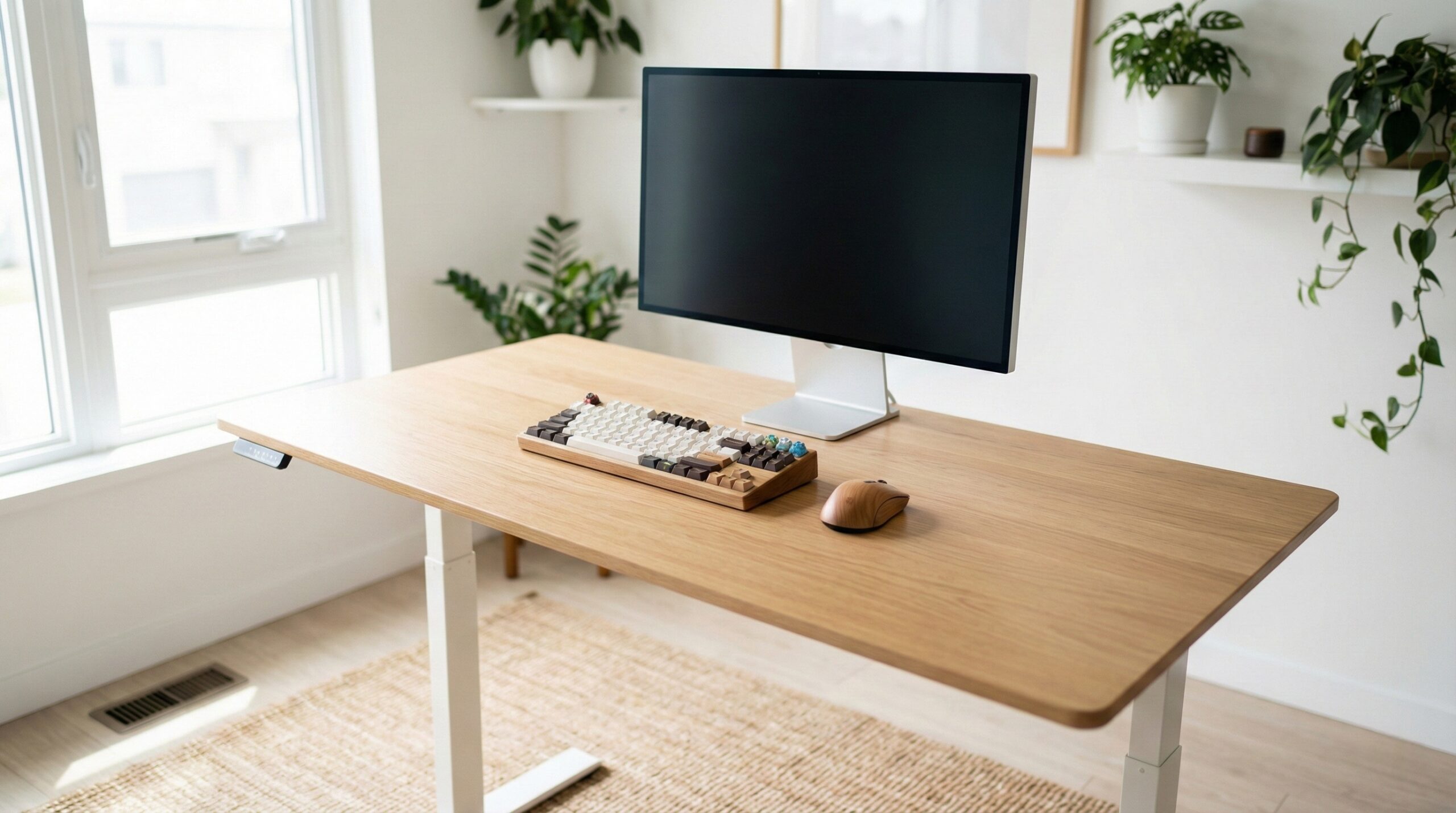
TL;DR
If you’re building your own sit-stand setup, a standing desk frame is the “engine”: legs, motors, feet, and electronics that lift your desktop. For most DIY builds, we’d start with a dual-motor, width-adjustable frame like the VIVO Dual Motor Electric Sit-Stand Desk Frame, then make sure it truly fits your top and stays stable at your standing height.
If you’re taller, use long monitor arms, or want maximum rigidity, consider a more stability-focused design (often 4-leg), but note many of those are sold as complete desks rather than frame-only.
What a Standing Desk Frame Actually Is
A standing desk frame (also called a sit-stand desk base) is the motorized understructure of an adjustable-height desk. It typically includes the lifting columns/legs, feet, telescoping rails that adjust for different top sizes, the motor(s), control box, handset/controller, and the power/cable harness. What it doesn’t include is the desktop itself — so you supply (or reuse) your own top.
That “frame-only” approach is popular for three reasons. First, it lets you reuse a desktop you already own (for example, a solid wood top you like) while upgrading the lift system. Second, it’s the most flexible route for custom sizing — if you want an extra-deep top, a butcher block, an odd width to fit an alcove, or a specific finish. Third, if your old sit-stand desk failed (common culprits are handsets/controllers, control boxes, and motor wiring), swapping the base can be cheaper than replacing an entire desk—as long as the new frame is compatible with your top and your height needs.
Performance comes down to a handful of factors:
- Desktop compatibility: the frame must support your top’s width/depth and provide rails/holes you can actually mount to. Expect to drill pilot holes unless your top was designed for that specific base.
- Stability at standing height: most wobble shows up when the legs are extended. If you work near maximum height (taller users especially), stability matters more than “max weight.”
- Motor configuration and real-world load: dual-motor frames generally lift more smoothly under heavier or uneven loads (monitor arms, a PC tower on one side, audio gear, etc.).
- Controller safety and usability: memory presets make daily sit/stand changes practical; anti-collision features help reduce pinch/crush risks (but aren’t perfect — keep clear during movement).
- Warranty/parts support: these are electromechanical systems. The best long-term value is often the frame you can still get a handset or control box for two years from now.
As you plan your setup, use basic ergonomics guidance as a reality check: you want a neutral wrist/forearm position for keyboard and mouse, and a monitor height/distance that doesn’t force neck flexion. OSHA’s workstation guidance is a solid starting point for positioning targets, even if you’re building a home office setup (OSHA computer workstation guidance). And remember that ergonomics guidance from NIOSH generally emphasizes varying posture rather than locking into prolonged static standing (NIOSH ergonomics resources).
Who Standing Desk Frames Fit Best
Standing desk frames make the most sense if you’re in one of these situations:
- You already have a great desktop. Solid wood, plywood, or a thick laminated top you like can pair well with a quality frame. (If it’s particleboard, you’ll want careful pilot holes or threaded inserts to prevent stripping.)
- You want a custom size. Many complete desks top out at common sizes; a frame plus custom top is how you get, say, a 72-inch-wide slab or an extra-deep workstation for drafting and multiple displays.
- You’re replacing a dead base. If the lift system failed but the top is fine, a new frame can get you back up quickly — just measure first, because rails and hole patterns vary.
- You want better lifting under heavier gear. Dual monitors on arms, a heavy desktop, a desktop PC, or a mic boom can push you toward a stronger, dual-motor base with a reputation for stability.
- You like DIY and don’t mind basic assembly. Building from a frame is straightforward, but you’ll be squaring the base, routing cables, and potentially drilling into your top.
If you’re unsure about your target heights (especially if you’re tall or petite), a certified ergonomist or occupational therapist can help you set sitting and standing positions that are realistic for your body and work tasks — often with simple tweaks like keyboard height, monitor placement, and foot support.
One common theme in home office worker reviews is that the “best” frame is the one that matches your top and doesn’t wobble at your standing height. In other words: fit first, stability second, then features.
Who Should Skip Standing Desk Frames
- You want a no-hassle purchase with minimal measuring. Frame-only means you must confirm desktop size, thickness, and mounting. If you don’t want to think about any of that, a complete desk kit is usually simpler.
- Your desktop is thin, hollow, or fragile. Some tops don’t hold screws well (or are too thin for safe mounting). You can sometimes use inserts or a reinforcement plate, but at that point a complete desk may be the safer route.
- You’re extremely sensitive to wobble. Any 2-leg sit-stand design can exhibit some movement at full extension, especially with monitor arms. If you know this will drive you crazy, look for designs built around higher rigidity (often 4-leg frames) or choose a complete desk known for stability.
- You rely on under-desk accessories. Deep keyboard trays, drawers, or cable trays can conflict with frame rails and control boxes. A complete desk (or a frame designed around those accessories) can reduce compatibility surprises.
- You need guaranteed compliance for commercial installations. For business procurement, you may need third-party performance/safety standards documentation. When available, benchmarks like ANSI/BIFMA desk testing are useful reference points (BIFMA ANSI/BIFMA X5.5 is a common desk products standard).
Price and Value
In the US market, standing desk frames range from budget DIY bases to premium commercial-grade systems. Based on current pricing for the options we’re highlighting here:
- Budget-to-midrange frame-only: The VIVO dual-motor frame is typically in the $200–$250 range, which is often the sweet spot for a basic dual-motor DIY build — assuming you’re realistic about stability at very tall heights and you assemble it carefully.
- Higher-stability designs (often sold as complete desks): The FlexiSpot E7 Plus 4-leg desk tends to land around $460–$540, but note this is positioned as a full desk system, not strictly a frame-only base in the way most DIY shoppers mean it.
- Premium complete-desk pricing: The UPLIFT Bamboo V2 listing we saw is in the $1400–$1500 range. That pricing reflects a complete desk package rather than a frame-only solution, and it’s overkill if your main goal is a cost-effective DIY base.
Also budget for the full build: desktop cost (which can easily match or exceed the frame), wood screws/bolts, a drill and bits, cable management, and possibly a monitor arm upgrade or a heavier top. Value isn’t just the sticker price — it’s how well the frame fits your top, how stable it is at your standing height, and whether you can get replacement parts (handset/control box/motor) without replacing everything.
Common Mistakes When Trying Standing Desk Frames
- Buying a frame before measuring your top. You need to confirm your desktop width and depth fall within the frame’s supported range, and make peace with where the rails will land. Extra overhang can amplify wobble.
- Underestimating “standing height” needs. Taller users (or anyone who uses a thick desktop + a tall keyboard/mouse setup) may end up near the top of the frame’s extension, where stability is hardest to maintain. If you’re near max height, prioritize rigidity features like longer feet or more robust leg columns.
- Treating weight capacity as the only spec. A monitor arm with screens extended forward creates torque that can make a desk feel shaky even if you’re well below the rated lift capacity. Think about leverage, not just pounds.
- Skipping a post-assembly bolt check. Slightly loose hardware is one of the most common causes of wobble and racking. After a week of use, re-check and snug everything (don’t overtighten into soft materials).
- Mounting accessories without planning clearance. Control boxes, rails, drawers, and cable trays fight for the same underside real estate. Dry-fit your layout before drilling.
- Relying too heavily on anti-collision. Anti-collision helps, but it may not detect smaller objects consistently. Keep hands, pets, and cables clear during motion.
If you’re troubleshooting an uneven lift or a desk that won’t move, start simple: check cable connections, confirm the handset is fully seated, and look up the reset procedure for your control box. If the issue repeats, that’s where warranty and parts access matter.
FAQ
Will my existing desktop fit a standing desk frame?
Sometimes, but not automatically. Measure your top’s width and depth, then compare to the frame’s supported top size range. Also check thickness (many tops work best when they’re thick enough to hold screws securely). Expect to drill new pilot holes unless your desktop was made for that specific base. If you’re unsure about monitor/keyboard positioning once installed, use OSHA computer workstation guidance as a setup reference.
Is a dual-motor standing desk frame always better than a single-motor?
Dual-motor is usually the safer pick for heavier or uneven loads (monitor arms, PC on one side, heavier tops) because it tends to lift more smoothly and resist racking. Single-motor frames can be fine for lighter setups (laptop + light monitor) if stability at your standing height is acceptable and the frame’s height range fits you.
How much weight capacity do I really need for a sit-stand frame?
Add up your real setup: desktop + monitors + monitor arms + speakers + PC + anything you keep on the desk. Then give yourself margin, because how weight is distributed matters. A forward-mounted monitor arm can make a desk feel less stable even when you’re well under the rated capacity.
How can I reduce wobble on a standing desk frame?
Start with the basics: tighten all fasteners, ensure the desk is level on the floor, and reduce excessive desktop overhang. If your frame offers a crossbar or stability add-on, it can help. Also try pulling monitor arms back (less forward extension) and keeping heavy items centered. Taller standing heights magnify movement, so stability-focused frames matter more if you work high.
What standing desk height is ergonomically correct?
Your standing height should allow relaxed shoulders and neutral wrists while typing/mousing — typically meaning the keyboard is around elbow height (with elbows roughly at a right angle). Monitor height should avoid neck strain (top of screen roughly at eye level for many people, adjusted to your comfort and vision needs). For practical setup targets, see OSHA computer workstation guidance. If you’re dealing with pain or a medical condition, a certified ergonomist or occupational therapist can help personalize the setup.
Is it OK to stand all day at a standing desk?
Most ergonomics guidance emphasizes changing posture rather than standing still for long periods. Build a routine where you alternate sitting and standing and take short movement breaks. For general ergonomics and musculoskeletal disorder prevention context, see NIOSH ergonomics resources.
What safety certifications or standards matter for electric standing desk frames?
For durability and stability, ANSI/BIFMA desk testing is a useful benchmark to look for in product documentation (often cited as ANSI/BIFMA X5.5 for desk products). For electrical safety, many reputable electric furnishings reference third-party testing/certification frameworks (for example, UL-related standards may apply to electrically operated components). If a brand is vague about safety testing or support, that’s a reason to be cautious.
Bottom Line
A standing desk frame is the best route if you want a custom desktop, you’re upgrading an existing top, or you’re replacing a failed base — just measure carefully and prioritize stability at your actual standing height. For many home office builds, a dual-motor, width-adjustable frame like the VIVO is a practical starting point, while stability-first designs (often 4-leg) are worth considering if you work tall or run long monitor arms.
If you want the least friction and the fewest compatibility surprises, skip frame-only and buy a complete sit-stand desk package instead.