TL;DR
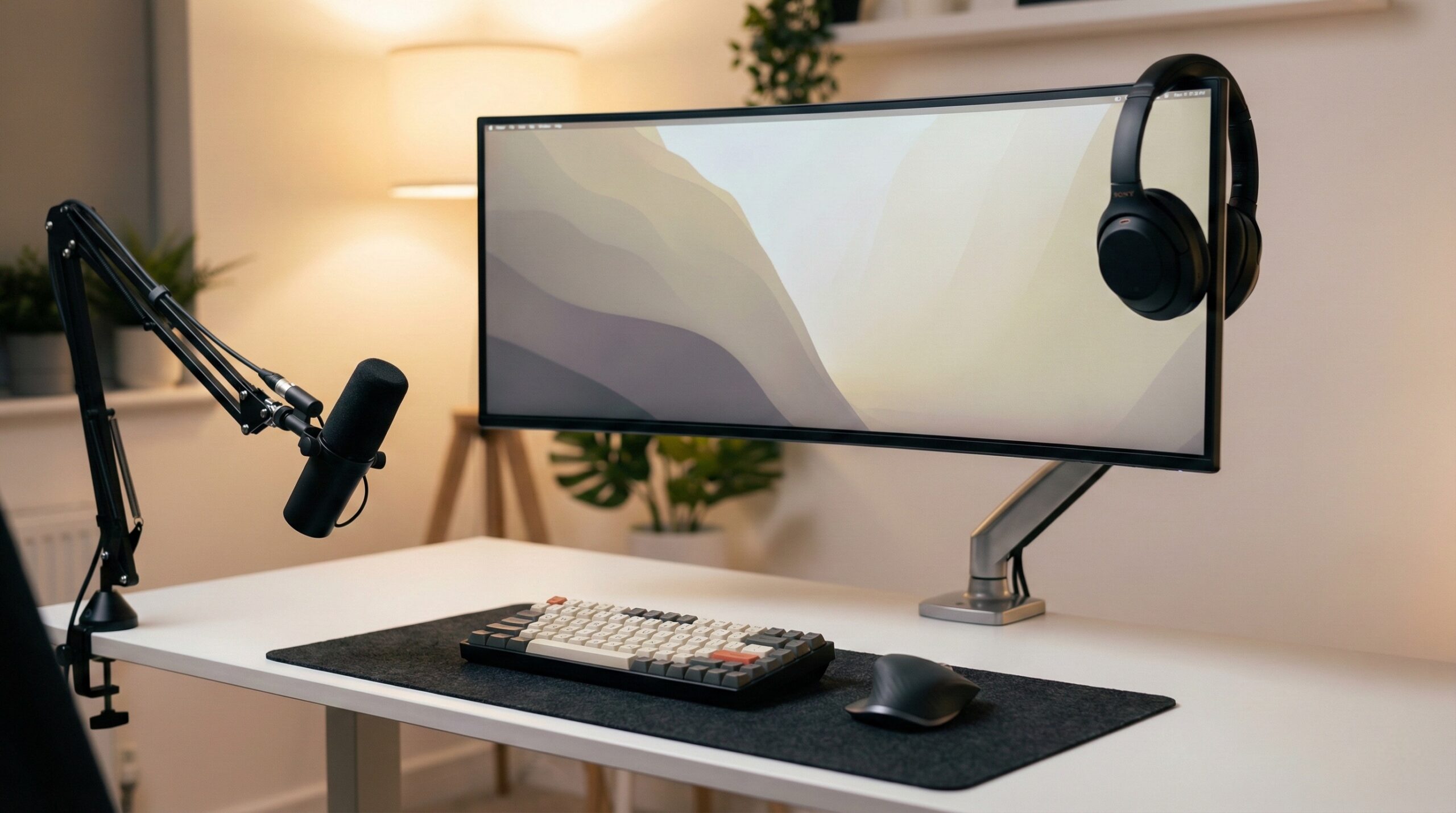
A good monitor arm is mostly a fit-and-stability purchase: confirm your monitor’s VESA pattern (usually 75×75 or 100×100), your total monitor weight with any accessories, and whether your desk can take a clamp or grommet mount. If those basics line up, a gas-spring arm makes it much easier to place your screen at a comfortable height and distance — and free up desk space compared to most stock stands.
Top Recommended Monitor Arms
| Product | Best For | Price | Pros/Cons | Visit |
|---|---|---|---|---|
| WALI GSM001XLN Single Monitor Arm 17-49 Inch | One large screen and frequent repositioning | $30 – $40 | Smooth gas-spring movement; setup and tension fine-tuning can take patience | Visit Amazon |
| MOUNT PRO Dual Monitor Mount 13-32 Inch | Budget dual-monitor setups on a clamp mount | $30 – $40 | Low-cost way to get two screens on arms; some users report tilt droop with certain heavy/curved monitors | Visit Amazon |
Top Pick: Best Overall Monitor Arm
WALI GSM001XLN Single Monitor Arm 17-49 Inch
Best for: a one-monitor home office setup where you regularly move the screen (sit/stand desk changes, sharing your screen on calls, fighting window glare) and want a smoother, more stable feel than a basic hinge arm.
The Good
- Smooth gas-spring height adjustment for day-to-day tweaks (useful if you switch between sitting and standing or you’re dialing in a new ergonomic setup).
- Helps reclaim desk space by getting the monitor base off your work surface — a real win on compact desks where the stock stand eats depth.
- Designed as a single-arm option that, per the listing, is intended to work with larger displays — a practical fit for someone using a big screen for spreadsheets, coding, or creative work.
- When properly tensioned, it’s the kind of arm that encourages you to adjust the monitor position instead of craning your neck (which is the point).
The Bad
- Fine-tuning can be fiddly: getting the tension and angles “just right” may take a few rounds of adjustments.
- Setup may require patience, especially if you’re new to gas-spring arms and don’t yet know which joint controls what.
- Like most clamp-mounted arms, you still need a desk edge that’s structurally solid — weak particleboard edges can flex or get dented if you overtighten.
4.4/5 across 17,413 Amazon reviews
“I recently picked up the WALI Single Monitor Mount for my desk setup, and I’m thoroughly impressed with the quality at this price point. It’s a massive upgrade over the stock stand, both in terms of ergonomics and reclaimed desk real estate.What stands out:Smooth Gas Spring Adjustment: The tension is easy to tune using the included hex key. Once dialed in,…” — Verified Amazon buyer (5 stars)
“Getting everything set up took a bit of time and patience. The adjustment system wasn’t the most intuitive at first, and I ran into some confusion while trying to dial in the right positioning. However, after working with it for a while, I was able to get it pretty close to exactly how I wanted it.One thing to note is that making very fine adjustments can…” — Verified Amazon buyer (4 stars)
Typical price: $30 – $40
“Smooth Gas Spring Adjustment: The tension is easy to tune using the included hex key. Once dialed in, moving the monitor up, down, or tilting i” — verified buyer, 5 stars
Our Take: If you want one monitor arm that feels smooth in daily use and can handle a wide range of real home-office scenarios (including larger screens), this WALI is the safest pick from our current shortlist — just plan on spending a little time dialing in tension and tilt after install.
MOUNT PRO Dual Monitor Mount 13-32 Inch
Best for: a budget two-monitor setup (for example, two 24-inch office monitors for admin work, customer support, trading dashboards, or school-from-home) where you want to clear desk space without paying for two separate premium arms.
The Good
- Budget-friendly way to get both monitors off their stock stands and open up usable desk depth.
- Dual-arm format is convenient if you’re building a first dual-monitor workstation and want a single mount point.
- Height adjustability makes it easier to align the two screens so your neck isn’t constantly rotating up/down between panels.
- Strong enough for many “typical” office monitors in the 22–27 inch range, based on how people commonly use arms like this in home offices.
The Bad
- Some buyers report tilt droop with specific heavier or curved monitors, even when the advertised capacity sounds sufficient on paper.
- Compared with higher-end dual arms (or two separate single arms), you may get less independent positioning flexibility depending on your desk depth and preferred spacing.
- Real-world hold strength can vary with monitor shape and center of gravity — a curved panel can put more leverage on the tilt joint.
4.4/5 across 4,149 Amazon reviews
“HOW THIS IS BEING USED: Using 2 of these for 2 HP ProDisplay P242va 24-inch Monitors, 6.39 lbs each, mounted on a Tangkula Mobile Standing Desk Computer Desk( https://www.amazon.com/dp/B06VSGY6DM?psc=1&ref=ppx_yo2ov_dt_b_product_details&tag=thedeskgear-20 ).11 MONITOR ARMS COMPARED: I compared specs, options and reviews for this and 10 other monitor arms ranging from $17 to…” — Verified Amazon buyer (5 stars)
“I have samsung odyssey g7 32” curved monitor and it weigh 11lb without the stand, this monitor arm advertised to hold up 17 lb? Which is way more than my monitor but unfortunately it keeps tilting down no matter how hard I tighted the screw.” — Verified Amazon buyer (1 stars)
Typical price: $30 – $40
“## Amazon Price History: **MOUNT PRO Dual Monitor Mount for 2 Ultrawide Computer Screen Max 43 Inch/37.5lbs Each, Premium Long Monitor Arm, Heavy Duty Gas Spring Monitor Stand for 2 Monitors, VESA Desk Mount 75×75 100×100**” — r/desksetup discussion
Our Take: This MOUNT PRO is a solid “get two screens on arms for cheap” choice for lighter, flatter monitors — but if you’re using a heavy curved 32-inch panel, we’d be cautious and consider a higher-capacity approach (often two sturdier single arms) to avoid tilt sag.
FAQ
Do all monitors work with monitor arms?
Most do, as long as your monitor has a VESA mounting pattern (commonly 75×75 or 100×100). Some very thin monitors and certain gaming models need a brand-specific VESA adapter, and a few aren’t compatible at all. Before you buy an arm, check your monitor’s manual or the manufacturer’s specs for VESA support.
How do I know if my monitor is too heavy for a monitor arm?
Check the arm’s stated weight range and compare it to your monitor’s weight including anything that adds load or leverage (light bar, webcam, heavier cables, or an adapter plate). If your setup is near the top of the range, it’s smart to size up: being too close to the limit can lead to droop over time, especially when the arm is extended.
Clamp vs grommet: which mount type is better?
A clamp mount is easiest if you have a strong, unobstructed desk edge. A grommet mount can feel more “locked in” on some desks, but it requires a hole in the desktop and enough clearance underneath for the hardware. If your desk has a back rail, apron, or a fixed cable tray, measure carefully because clamp hardware may not seat correctly.
Will a monitor arm help with neck and shoulder pain?
It can, if it lets you place the monitor at a healthier height and distance so you’re not constantly looking down or leaning forward. OSHA’s guidance generally supports keeping the screen positioned so your head and neck stay in a neutral posture, with comfortable viewing distance and minimal glare; see OSHA computer workstation guidance. If your chair height, desk height, or keyboard/mouse position is off, a monitor arm alone won’t fix everything — a certified ergonomist or occupational therapist can help you troubleshoot the full setup.
How high should my monitor be when using a monitor arm?
A practical target is to get the top of the screen roughly at eye level, with the center of the screen slightly below your natural eye line. That typically reduces neck flexion compared with a low stock stand. If you wear progressive lenses, you may need the monitor a bit lower to avoid tipping your head back.
Why does my monitor wobble when it’s on an arm?
Common causes include: the arm being extended far out (more leverage), a flexible desktop, loose clamp hardware, loose pivot joints, or gas-spring tension that isn’t set for your monitor’s real weight. Budget arms can also transmit more vibration while you type, especially at full extension. After install, re-check bolts and tension after a day or two because things can settle.
Do dual monitor arms position as well as two single arms?
Sometimes, but not always. Dual arms can be a good value, but they may limit independent height and reach depending on how the mount is designed. If you need each screen in a very specific spot (for example, one centered and one off to the side, or a deep desk where you want one screen pushed back), two single arms often give you more flexibility.
Bottom Line
For most home office workers, the “best monitor arm” is the one that matches VESA (usually 75×75 or 100×100), comfortably supports your monitor’s real weight, and fits your desk’s clamp or grommet constraints. The WALI GSM001XLN is our best overall pick here because it’s built around smooth gas-spring adjustment and works well for common one-monitor setups — just expect to spend a bit of time dialing in the tension and joint friction after installation.
Affiliate disclosure: This page includes affiliate links. Purchases through these links support our work at no added cost.