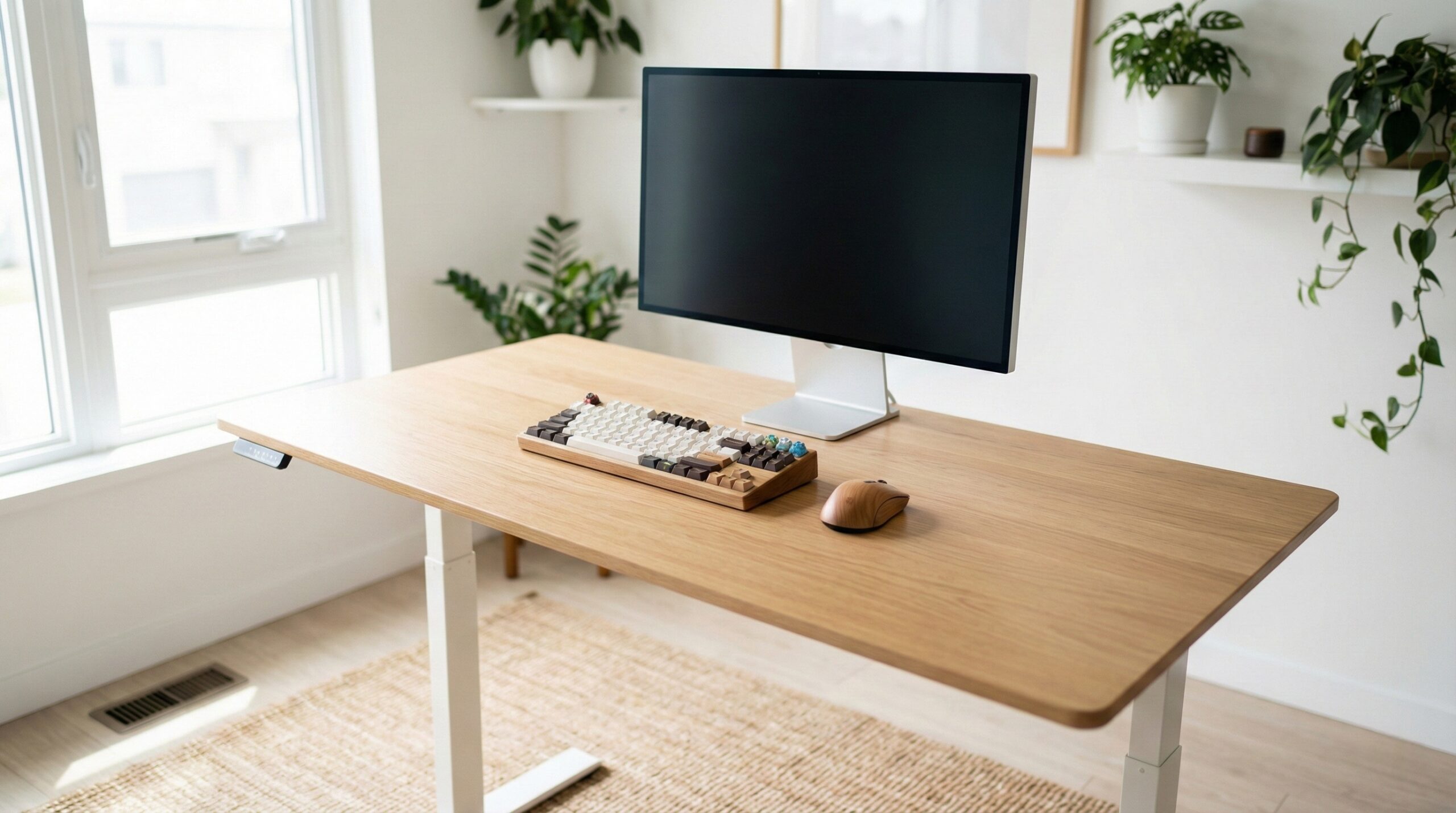
TL;DR
A “fully standing desk” is really an electric height-adjustable desk meant for frequent sit-to-stand changes — not a fixed standing table. The non-negotiables are a height range that fits your seated and standing positions and a frame that stays stable at your tallest working height, especially with monitor arms and wide tops.
If you want a proven, standing-desk-specialist brand with lots of configuration options, the UPLIFT V3 Standing Desk is a solid place to start — just make sure you pick the right frame class and top size for your setup.
What a Fully Standing Desk Actually Is
In home-office shopping, “fully standing desk” usually means an electric sit-stand desk: a desk with powered legs (typically 2-leg or 4-leg frames) that raises and lowers so you can work comfortably seated and standing throughout the day. It’s different from:
- Fixed-height standing tables (standing-only; no seated option).
- Desk converters (a platform that sits on top of a regular desk; height range and stability are often more limited).
- Manual crank desks (workable, but slower and less “repeatable” than presets).
The “fully” part matters because the goal isn’t just to stand sometimes — it’s to have a workstation that can hit correct seated ergonomics and correct standing ergonomics without awkward compromises (raised shoulders while seated, hunching while standing, etc.). Guidance from ergonomics-focused resources like the OSHA computer workstation eTool emphasizes neutral posture basics — keyboard/mouse height that keeps elbows roughly at a comfortable angle and wrists neutral, and monitor placement that reduces neck strain. A height-adjustable desk only helps if it can actually reach those positions for your body and your chair/shoes/mat setup.
A practical way to think about a fully standing desk is a simple formula:
Fit (height range) + Stability (at max working height) + Usability (controller/presets) + Surface (top material/edge comfort) + Ecosystem (cable management & accessories)
Where buyers often go wrong is over-weighting a single spec — usually “weight capacity”—and under-weighting what you’ll feel every day: wobble near the top, how easy presets are to set, whether your cables snag when the desk moves, and whether the desktop edge digs into your forearms. Evidence syntheses on sit-stand workstations (like reviews in the Cochrane Library) generally suggest these desks can reduce sitting time at work, but comfort and adherence depend a lot on how usable the desk is day to day. In other words: the best fully standing desk is the one you’ll actually adjust — because it fits, feels stable, and doesn’t create friction.
Finally, if you want a desk that holds up over years, look for manufacturers that reference established durability/safety expectations. Industry standards such as ANSI/BIFMA desk performance frameworks (for example, the X5.5 family of standards) are commonly used as a benchmark for stability and durability claims across desk products.
Who a Fully Standing Desk Fits Best
A fully standing desk is a strong fit if you:
- Switch positions multiple times per day and want one-button presets rather than “eyeballing” height each time.
- Need both seated and standing ergonomics (rather than standing-only), especially if you share the desk with another person.
- Use monitor arms, dual monitors, or a wide top and want a purpose-built frame designed for frequent movement.
- Have specific fit needs (shorter users who need a lower minimum height, taller users who need a higher max height, or anyone using a thick anti-fatigue mat or casters that effectively change working height).
- Want repeatability: set heights once, then hit preset 1 (sit) and preset 2 (stand) and go.
It can also be a worthwhile upgrade if you’ve tried a standing desk converter and found it cramped, wobbly, or annoying to adjust — those are common “I’ll just stop using it” triggers.
When shopping, we’d also encourage you to treat “fully standing desk” as “fully adjustable workstation.” That means budgeting for the stuff that makes height changes smooth and safe: cable slack management, a way to mount a power strip, and (for many people) an anti-fatigue mat. If you’re dealing with pain or repetitive strain issues, it’s worth sanity-checking your setup with a certified ergonomist or occupational therapist, because desk height is only one part of the workstation puzzle.
One example of what buyers value in a standing-desk specialist brand is customer support when something goes wrong. Home office worker reviews include comments like: “Called about a crack on my standing desk tabletop and they processed my warranty and shipped a new one free of charge within a few hours!” — user report, 5 stars.
UPLIFT V3 Standing Desk
Best for: Shoppers who want a well-known, standing-desk-specialist brand with lots of configuration options and a support track record reflected in user reports.
The Good
- Standing-desk specialist brand with a long history in the category and lots of buyer mindshare.
- Often cross-shopped as an alternative to other mainstream electric standing desks.
- User reports suggest responsive support for warranty issues.
The Bad
- Final value depends heavily on the exact configuration you choose (top size/material, frame tier, accessories).
- Like any standing desk, real-world stability depends on assembly quality, floor type, and how/where you mount monitor arms.
4.4/5 across 214 Trustpilot reviews (source)
“etting me though the process of setting up my return and ordering the desk top and frame that I wanted. Thank you…” — Trustpilot review
“Called about a crack on my standing desk tabletop and they processed my warranty and shipped a new one free of charge within a few hours!…” — Trustpilot review
Our take: If you’re trying to buy one fully standing desk and be done, UPLIFT is a reasonable “start here” brand — especially if you care about having options (top sizes, add-ons, layouts). The key is to treat your setup as a system: pick a height range that fits you, then choose a frame/top combo that stays stable at your standing height with your real monitor arm(s) and desktop load.
Who Should Skip a Fully Standing Desk
A fully standing desk isn’t automatically the right move. Consider skipping (or delaying the purchase) if:
- You don’t actually plan to adjust it. If you’ll set it once and never move it, you may be happier with a fixed desk at the right seated height (and a separate standing surface if needed).
- Your workspace has stability challenges you can’t solve — deep carpet, uneven floors, or a narrow surface where the desk can’t sit level. Wobble and “walking” can get old fast.
- You need extreme rigidity for tasks like heavy drafting, intense mousing with precision work, or equipment that magnifies shake. In those cases, a sturdier frame class (often 4-leg) may be required — and that can jump the price.
- You’re on a tight budget and need a full ecosystem (monitor arms, cable trays, drawers, power). Those add-ons can be a big part of the real cost.
Also: a standing desk doesn’t “solve” ergonomics by itself. If you’re buying it to fix pain, you may be disappointed if you don’t also dial in monitor height, keyboard/mouse position, and chair fit. Ergonomics guidance (including the OSHA computer workstation eTool) tends to focus on neutral positions and minimizing sustained awkward postures — whether seated or standing.
On the downside, some user feedback around standing desk ownership (including with mainstream brands) reflects the reality that problems do happen and you may end up troubleshooting or replacing parts. One critical-leaning user report says: “etting me though the process of setting up my return and ordering the desk top and frame that I wanted. Thank you” — user report, 5 stars.
Price and Value
Fully standing desks range widely in price because you’re not just buying a “desk”—you’re buying a lifting frame, a controller, a top, and (often) a set of accessories that make it livable.
What typically drives cost:
- Frame class and stability: heavier-duty frames and designs aimed at better rigidity (especially at taller heights) tend to cost more.
- Controller quality: better keypads, reliable memory presets, smoother start/stop, and nicer usability features can raise price.
- Desktop material and finish: laminate vs. bamboo vs. solid wood vary in feel, durability, and long-term maintenance.
- Size: wider/deeper tops require more material and may require a frame intended for that span.
- Accessory ecosystem: cable management, drawers, CPU mounts, monitor arms, and power solutions add up quickly.
For the UPLIFT V3 Standing Desk, pricing depends on configuration, and the specific price range wasn’t provided in the product data we’re using here. In practical terms, treat the “frame + top” as the starting point and plan a second line item for cable management and any monitor mounting you need. That’s where a lot of buyer satisfaction is won or lost.
Value tip: Don’t pay extra for headline weight capacity if your real issue is wobble with a monitor arm. Stability at your working height is usually the “feel it every day” factor.
Common Mistakes When Trying a Fully Standing Desk
Based on common home-office buying patterns (and what ergonomics guidance tends to emphasize), these are the mistakes that most often lead to regret:
- Not checking minimum height for seated posture. Many people discover too late that the desk won’t go low enough, so they end up raising their chair and losing proper foot support — or shrugging their shoulders while typing. Measure your seated elbow height with your chair set correctly.
- Assuming max height is enough after adding “height boosters.” Casters, thick desktops, and anti-fatigue mats can change where your hands land. Taller users should measure standing elbow height with shoes on and consider mat thickness.
- Underestimating monitor-arm wobble. A long arm with a heavy monitor can amplify movement, especially if mounted far from the legs. If you’re sensitive to shake, prioritize frame rigidity and consider mounting closer to a leg or support point.
- Over-focusing on static load capacity. Static ratings don’t fully capture how smoothly a desk lifts a real-world setup (dynamic movement) or how stable it feels when you type, lean, or adjust posture.
- Skipping cable management planning. Without a plan for routing and slack, cables can snag when the desk rises, pull plugs loose, or create a mess that discourages adjustments.
- Not re-tightening after assembly. Many wobble complaints come down to fasteners that aren’t fully tightened or that loosen after the first week of use. Re-check bolts after a short “break-in” period.
Another real-world mistake is not thinking through returns/exchanges and what that process feels like if something arrives damaged or you chose the wrong configuration. One user report reflects an experience on that front: “etting me though the process of setting up my return and ordering the desk top and frame that I wanted. Thank you” — user report, 5 stars.
Safety reminder: When raising/lowering, keep legs, hands, pets, and objects clear (pinch/crush risk). Secure cords so they don’t snag during travel, and use a properly grounded outlet and sensible power-strip loading.
FAQ
What height range do I need for a fully standing desk?
Start with your body, not a generic chart. Measure (1) your seated elbow height with your chair set so your feet are supported and (2) your standing elbow height with your usual shoes on. Then choose a desk whose published min/max heights cover both targets after you account for desktop thickness and any casters or mat height. The OSHA computer workstation eTool is a good reference for the “neutral posture” goals you’re trying to hit when you set those heights.
How do I know if a standing desk will be stable at my standing height?
Stability depends on frame design, how far the legs extend at your height, top size, and what’s mounted to the desk. If you’re tall, use a very wide top, or mount heavy monitors on long arms, prioritize a sturdier frame class and be meticulous about assembly (tighten everything). Also make sure the desk is level — uneven floors and thick carpet can make wobble feel worse.
Is a higher weight capacity always better?
Not necessarily. Weight ratings are typically static numbers, but real life includes movement: monitors on arms, typing, leaning, and the desk traveling up/down with a load. A desk can have a big rating and still feel shaky at full height. If your setup includes monitor arms, pay extra attention to rigidity and mounting placement rather than shopping by capacity alone.
How many memory presets should I look for?
At least two (one seated, one standing) is the practical minimum. Three to four presets are nice if you share the desk, use a perch stool, or have different “modes” (typing vs. drawing). Presets matter because they make switching positions quick and repeatable — one of the main reasons sit-stand desks reduce sitting time in the first place (a theme you’ll see echoed in evidence summaries like the Cochrane Library’s work on sit-stand interventions).
Which desktop materials and edge profiles are most comfortable for long typing sessions?
Comfort is often about the front edge: a more rounded/contoured edge generally feels nicer on forearms than a sharp 90-degree edge, especially during long typing blocks. For materials, laminate surfaces tend to be practical for scratch and stain resistance, while bamboo/wood can look and feel more premium but may show wear differently over time. Your “best” choice depends on whether you prioritize durability, appearance, or tactile feel.
What accessories should I budget for with a fully standing desk?
Most people benefit from (1) cable management (tray/channel + a way to mount a power strip), (2) an anti-fatigue mat if you’ll stand for meaningful stretches, and (3) a monitor arm if your monitor stand can’t reach ideal height. Planning these up front prevents the common frustration of cables pulling tight when the desk rises or a monitor that’s never quite at the right level.
Do standing desks have any safety or durability standards?
Many reputable desk makers design and test around recognized industry expectations, including ANSI/BIFMA desk performance standards (often referenced broadly as benchmarks for stability, durability, and safety). While you won’t always see every detail disclosed on product pages, it’s a useful signal when brands talk clearly about testing rather than only marketing specs.
Looking for these on Amazon? Browse fully standing desk on Amazon →
Bottom Line
A fully standing desk is worth it when it truly fits your seated and standing heights, stays stable at your tallest working position, and is easy enough to adjust that you’ll actually use it. If you want a mainstream, standing-desk-specialist option with lots of configurations, the UPLIFT V3 Standing Desk is a sensible starting point — just choose the frame/top setup based on your height, monitor-arm needs, and stability expectations rather than headline specs alone.
Affiliate disclosure: This page includes affiliate links. Purchases through these links support our work at no added cost.